
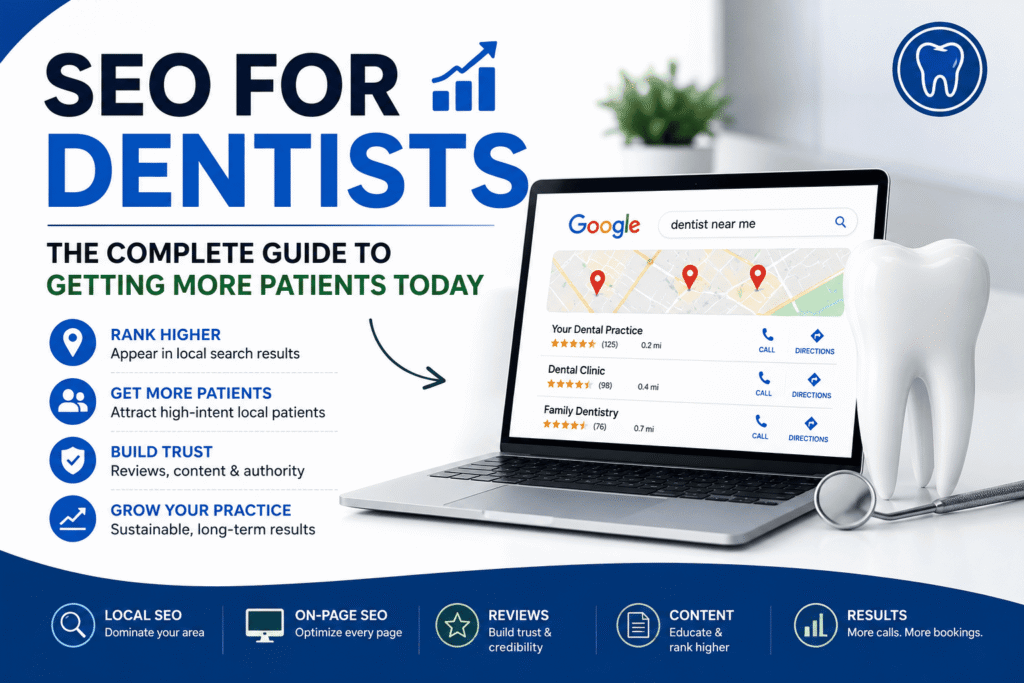
Every day, thousands of people in your city open Google and type “dentist near me.” They are ready to book. The only question is whether your practice shows up — or your competitor’s does.
That’s the entire game with dental SEO.
This guide breaks down exactly how search engine optimization works for dental practices, what actually moves the needle in 2025, and the specific steps you can take to start ranking higher, attracting more local patients, and filling your appointment book. Whether you run a solo practice or a multi-location clinic, this is the strategy you need. What Is SEO for Dentists (and Why Does It Matter)?
SEO — search engine optimization — is the process of improving your dental practice’s visibility on Google so that more potential patients find you when they search for services you offer.
When someone searches “teeth whitening [your city]” or “emergency dentist near me,” Google evaluates hundreds of ranking factors to decide which practices appear at the top. SEO is the work you do to influence those factors in your favor.
Here’s why this matters more than ever:
- 77% of patients use search engines to find healthcare providers before booking (source: Google/Ipsos Health Survey)
- The top three Google local results (the “Local Pack”) capture the vast majority of clicks
- Patients who find you through organic search are already high-intent — they are actively looking for what you offer
Unlike paid ads, which stop the moment your budget runs out, SEO compounds over time. A well-optimized dental website keeps generating patient leads month after month, year after year.
How Patients Find Dentists Online
Understanding the patient journey is critical before you optimize anything.
Most prospective patients follow a predictable path:
Step 1 — Trigger: They need dental care (toothache, new to the area, overdue for a cleaning).
Step 2 — Search: They Google something like “dentist near me,” “affordable dentist [city],” or a specific service like “Invisalign provider [city].”
Step 3 — Evaluate: They look at Google’s local results, scan reviews, visit 2–3 websites, and compare.
Step 4 — Contact: They call, fill out a form, or book online.
Your SEO strategy must win at Steps 2 and 3. That means appearing in search results AND presenting a website that converts visitors into booked patients.
The Foundation: Your Dental Website
Your website is the hub of your entire digital presence. Before doing anything else, it needs to meet a baseline standard.
What a High-Performing Dental Website Needs
A clear homepage that immediately communicates who you are, where you’re located, and what you specialize in. Your city and neighborhood should appear in prominent text — not just in the footer.
Dedicated service pages for every treatment you offer. One page for teeth whitening. One for dental implants. One for Invisalign. One for emergency dentistry. Each page targets a specific keyword and gives Google a clear signal about what you do.
A fast load time. Google uses page speed as a ranking factor. If your site takes more than 3 seconds to load, you’re losing both rankings and patients. Use Google’s PageSpeed Insights to check your score.
Mobile optimization. Over 60% of local searches happen on mobile devices. If your site isn’t easy to navigate on a phone, patients will bounce — and Google notices.
Clear calls to action. Every page should make it obvious how to book an appointment. Phone number in the header. A “Book Now” button above the fold. A contact form that works on mobile.
Trust signals. Photos of your actual team (not stock photos), your credentials, years in practice, professional memberships, and patient testimonials all build the kind of trust that converts visitors into patients.
Local SEO: The Most Important Ranking Factor for Dentists
If there is one area of SEO that deserves the most attention for dental practices, it is local SEO. Dentistry is inherently local — people will not drive 45 minutes for a cleaning. They want someone nearby, and Google knows this.
Local SEO determines whether your practice appears in the Google Local Pack (the map with three business listings that appears at the top of local searches). This is prime real estate. Studies consistently show that the Local Pack captures more clicks than the organic results below it.
Optimizing Your Google Business Profile
Your Google Business Profile (GBP) is the single most powerful local SEO tool available to dentists — and it’s free.
Here’s how to optimize it fully:
Choose the right primary category. “Dentist” is the obvious choice, but you can add secondary categories like “Cosmetic Dentist,” “Emergency Dental Service,” or “Pediatric Dentist” depending on your specialties.
Complete every section. Business name, address, phone number, website URL, hours, services, and a thorough business description. Leave nothing blank.
Add high-quality photos. Practices with photos receive 42% more direction requests and 35% more clicks than those without. Upload photos of your reception area, operatories, team, and exterior.
Use the services section. List every service you offer with descriptions. This directly influences which searches your profile appears for.
Post regularly. Google Posts — updates, offers, events — keep your profile active and signal engagement to Google. Post at least once a week.
Enable messaging and booking. Make it as easy as possible for patients to contact you directly from your profile.
NAP Consistency Across the Web
NAP stands for Name, Address, and Phone Number. Your NAP must be identical across every online listing — your website, Google Business Profile, Yelp, Healthgrades, Zocdoc, Facebook, and everywhere else.
Even small inconsistencies (like “Street” vs “St.” or an old phone number) confuse Google and hurt your local rankings.
On-Page SEO for Dental Practices
On-page SEO is the optimization you do directly on your website pages. This is where you tell Google exactly what each page is about.
Keyword-Optimized Title Tags and Meta Descriptions
Every page on your website needs a unique title tag and meta description. For a dental implants page, a strong title might be: “Dental Implants in [City] | [Practice Name] — Natural-Looking Results.”
Your primary keyword should appear naturally in the title tag, the H1 heading, the first paragraph, and at least one subheading.
Create Individual Service Pages
This is one of the highest-impact SEO moves a dental practice can make. Instead of listing all your services on a single page, give each major service its own dedicated page.
A page for “Invisalign in [City]” can rank for all Invisalign-related searches in your area. A page titled “Teeth Whitening in [City]” does the same. Each page targets a specific patient need.
Use Schema Markup
Schema markup is structured data you add to your website’s code to help Google understand your content better. For dentists, the most valuable schemas are:
- LocalBusiness / Dentist schema — confirms your name, address, phone, hours, and specialty
- FAQPage schema — helps FAQ content appear directly in search results
- Review schema — can display star ratings in search snippets
If you’re on WordPress, plugins like Rank Math or Yoast SEO can add schema without touching any code.
Content Marketing That Builds Trust and Rankings
A dental blog might seem unnecessary — but it is one of the most effective long-term SEO strategies available.
Every article you publish is another opportunity to appear in Google search results. More importantly, educational content establishes your practice as a trusted authority in patients’ minds before they ever call you.
What to Write About
Focus on questions your patients actually ask. Some proven content ideas for dental blogs:
- “How Long Do Dental Implants Last?”
- “What to Expect During a Root Canal”
- “Invisalign vs Traditional Braces: Which Is Right for You?”
- “How to Get Rid of Bad Breath Permanently”
- “Is Teeth Whitening Safe for Sensitive Teeth?”
Each of these targets real search queries. When someone finds your article helpful, they are far more likely to trust you with their dental care.
Write for E-E-A-T
Google evaluates dental content through the lens of E-E-A-T — Experience, Expertise, Authoritativeness, and Trustworthiness. Health content faces especially high scrutiny because it falls under “Your Money or Your Life” (YMYL) guidelines.
To demonstrate E-E-A-T on your dental website:
- Credit articles to named dentists or staff with credentials listed
- Link to reputable sources (ADA, NIH, peer-reviewed studies)
- Keep content accurate and up to date
- Include an “About the Author” section with the dentist’s qualifications
Building Authority with Backlinks and Citations
Backlinks — links from other websites pointing to yours — are one of Google’s most important ranking signals. The more authoritative websites that link to your practice, the more Google trusts your site.
How Dentists Build Legitimate Backlinks
Local citations: Getting listed on directories like Yelp, Healthgrades, Zocdoc, WebMD’s Find a Doctor, and local chamber of commerce websites builds both citations and backlinks.
Local press: Sponsor a local event, contribute to a community story, or get featured in a local news article. Local news sites carry real SEO authority.
Dental associations: Membership in the American Dental Association (ADA), your state dental association, or local dental societies often includes a directory listing with a backlink.
Guest content: Write an article for a local health publication, wellness blog, or community website. Include a link back to your practice.
Partnerships: Partner with nearby businesses — orthodontists, pediatricians, ENT specialists — and exchange mentions or referral links.
Online Reviews: Your Reputation Is a Ranking Signal
Reviews affect both your Google rankings and your conversion rate. A practice with 200 positive reviews will outrank and out-convert a practice with 12 reviews almost every time.
Google uses review quantity, recency, rating, and diversity as ranking signals for local results. Patients read reviews before choosing a dentist — 84% of people trust online reviews as much as a personal recommendation.
How to Get More Google Reviews
The most effective method is the simplest: ask. After a positive appointment, ask the patient directly if they’d be willing to leave a review on Google. Most happy patients will if you make it easy.
Make it easy by:
- Sending an automated post-appointment text or email with a direct link to your Google review page
- Including a QR code at checkout that links to your review page
- Training front desk staff to mention reviews as part of checkout
Always respond to reviews — both positive and negative. Responding shows Google (and potential patients) that you are engaged. For negative reviews, respond calmly, professionally, and offer to resolve the issue offline.
Technical SEO Basics Every Dentist Should Know
Technical SEO ensures that Google can properly crawl, index, and rank your website. You don’t need to be a developer, but you should be aware of these basics.
HTTPS: Your site must have an SSL certificate (the padlock in the browser address bar). Google explicitly favors secure sites, and patients won’t trust a non-secure dental website.
Core Web Vitals: Google measures user experience through metrics like page load speed, visual stability, and interactivity. Check your scores in Google Search Console.
Mobile-first indexing: Google primarily uses the mobile version of your website for ranking. Test your site on multiple devices and screen sizes.
Crawlability: Make sure Google can access and index all your important pages. A simple way to check: go to Google Search Console and inspect individual URLs.
Fix broken links: Broken internal and external links hurt user experience and signal neglect to Google. Run a free site audit with tools like Screaming Frog or Semrush.
How Long Does Dental SEO Take?
This is the most common question dental practice owners ask — and the honest answer is: it depends, but typically 3 to 6 months for noticeable results, and 6 to 12 months for significant ranking improvements.
SEO is not a paid ad. You’re building long-term authority, and that takes time. However, some actions produce faster results:
- Optimizing your Google Business Profile can improve local rankings within weeks
- Fixing critical technical issues can produce quick gains
- Earning your first batch of new reviews can noticeably improve your local pack position quickly
The practices that win at dental SEO are the ones that treat it as an ongoing investment, not a one-time project. Consistent effort compounds into dominant rankings over time.
Common Dental SEO Mistakes to Avoid
Even well-intentioned SEO efforts can backfire. Here are the most common mistakes dental practices make:
Using a generic, template website. If your website looks identical to 500 other dental sites using the same platform, Google and patients can tell. Unique content and design signal authenticity.
Ignoring Google Business Profile. Leaving your GBP incomplete or unmanaged is leaving patients on the table.
Targeting only broad keywords. “Dentist” is too competitive. “Family dentist in [neighborhood], [city]” is more achievable and more specific to what patients actually search.
Not building citations. If your practice isn’t listed on major directories, you’re missing easy wins that competitors are probably already capturing.
Publishing thin content. A 200-word service page tells Google almost nothing. Comprehensive, helpful pages consistently outrank shallow ones.
Ignoring reviews. Not asking for reviews and not responding to existing ones is a missed opportunity on both the SEO and conversion fronts.
Expecting overnight results. Abandoning SEO after two months because you haven’t seen results is the number one way dental practices fail at organic search.
Frequently Asked Questions
Is SEO worth it for dentists?
Yes — for most dental practices, SEO delivers one of the highest returns on investment of any marketing channel. Unlike paid ads, organic rankings generate patient leads without a cost-per-click. A patient acquired through SEO may stay with your practice for years, making the lifetime value of that ranking far higher than a single appointment.
How long does SEO take to work for a dental practice?
Most practices see meaningful improvement in 3 to 6 months with consistent effort. Full competitive rankings in major cities can take 9 to 18 months. Local pack rankings through Google Business Profile optimization tend to improve faster — sometimes within weeks.
How do I get my dental practice to show up on Google Maps?
Optimize your Google Business Profile completely, ensure your NAP is consistent across all online listings, accumulate genuine patient reviews, and add your practice to major local directories. The Local Pack ranking is driven primarily by proximity, relevance, and prominence — all three of which you can influence through local SEO.
What keywords should dentists target for SEO?
Start with geo-targeted service keywords: “[service] in [city],” “[service] near [neighborhood],” and “[specialty] dentist [city].” Examples include “dental implants in Austin,” “emergency dentist near downtown Chicago,” and “pediatric dentist Brooklyn.” Also target question-based keywords your patients actually type, like “how much does Invisalign cost” or “are dental implants painful.”
How much does dental SEO cost?
Dental SEO services typically range from $500 to $3,000+ per month depending on the market, competition, and scope of work. Highly competitive urban markets cost more. You can also do some SEO yourself — particularly Google Business Profile optimization and review generation — at no financial cost.
What is the difference between local SEO and regular SEO for dentists?
Local SEO focuses on ranking in geographically specific searches and the Google Local Pack — the map results that appear for “near me” and city-based searches. Regular (organic) SEO focuses on ranking in the standard blue-link search results. For dentists, local SEO is typically the higher priority because most patients search by location.
Can I do dental SEO myself, or do I need an agency?
You can absolutely handle foundational SEO tasks yourself — optimizing your Google Business Profile, managing reviews, and publishing helpful content on your website. However, technical SEO, competitive keyword strategy, link building, and ongoing optimization are time-intensive and require expertise. Many practices handle the basics in-house and hire an agency for more advanced work.
How do online reviews affect dental SEO?
Reviews directly influence your Google Business Profile ranking — practices with more high-quality, recent reviews consistently rank higher in the Local Pack. Reviews also influence click-through rates and patient trust, which means they indirectly affect your organic rankings too. A steady stream of genuine positive reviews is one of the most powerful things you can do for dental SEO.
Conclusion
SEO for dentists isn’t optional anymore — it’s the foundation of patient acquisition in 2025. The practices ranking at the top of Google aren’t there by accident. They’ve built optimized websites, mastered their Google Business Profile, earned strong reviews, published helpful content, and stayed consistent over time.
The good news: most of your local competitors aren’t doing this well. The bar to outrank them is achievable, and the reward — a steady flow of new patients finding you organically every month — is worth every bit of effort.
Start with your Google Business Profile. Then work through your website’s service pages. Build citations, ask for reviews, and publish content that answers your patients’ real questions. Each step compounds on the last.
If you want to move faster and take dental SEO completely off your plate, our team at mdesmail.com specializes in exactly this — ranking dental practices in competitive local markets. We’ve done it before, and we can do it for yours.